In Mayumi’s case
I never imagined there could be an inherited disease that cannot be cured.
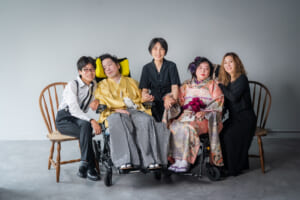
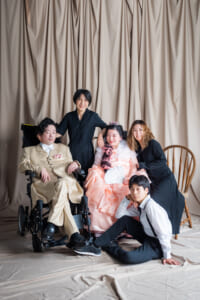
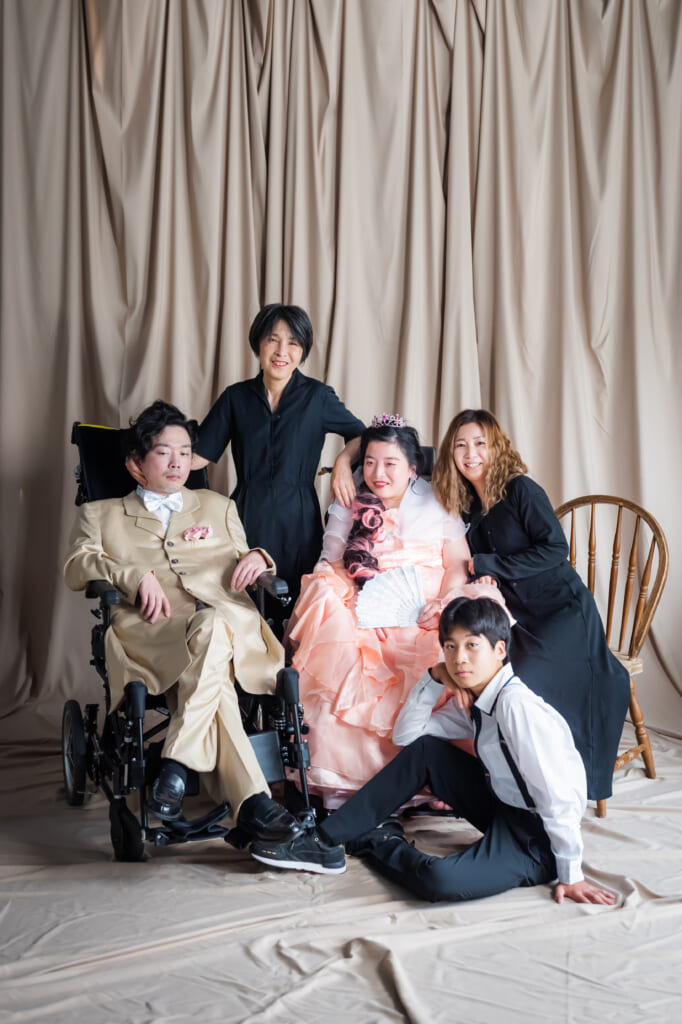
I have three children: my oldest son Hikaru, my oldest daughter Aya, and my younger daughter. Hikaru is now 40 years old, and both Hikaru and Aya developed DRPLA.
Hikaru started having trouble keeping up with schoolwork when he was in upper elementary school.
At that time, the word “learning disability” was being talked about a lot, and I thought maybe Hikaru had that. I contacted many places, but I never got an answer.
I tried to find something he could be good at, so I had him try many things.
I was desperate to find even one small ray of light in the darkness.
Aya started to show selfish behavior from the time she was in elementary school.
I felt strongly that I had to find something for her too.
At that time, I didn’t know about the disease, so I was desperately searching for answers.
While I was struggling, Hikaru had his first epileptic seizure.
At that time, it was said that bright flashing lights could cause seizures.
Hikaru was playing a game in the toy section of a supermarket when he had a seizure. I regretted it so much. I thought, “It happened because I didn’t pay enough attention.”
Hikaru also could not keep up with schoolwork and stopped going to school.
Still, I thought I had to do something, so I found a free school and sent him there.
Hikaru kept having seizures many times, even though he was taking epilepsy medicine.
Now I think maybe I didn’t take it seriously enough. I thought, “Maybe epilepsy is just like this.”
All I could think about was, “I have to find a future for him, I have to find a path for him.”
***
I also had other worries.
When the children were little, my ex-husband had a brain hemorrhage. After that, he did not work and stayed home all the time.
I went out to work, but even though he was at home, he did not feed the children even when I left meals prepared.
The children were hungry, but he just slept. This continued, and finally, we divorced.
Maybe my husband’s illness had already started at that time. If I had known about the disease, maybe I would not have divorced him.
After that, I had to raise the children, so I worked very hard to make a living.
When Aya also started having seizures, my youngest daughter began to worry, “Will I also have seizures someday?”
We had a pediatrician check her and somehow managed to get through that time. But then Hikaru’s mental state started to break down, and he began hitting his younger sister.
Sometimes it was so bad we had to call an ambulance. I remember hearing him tell the paramedics, “I am also hurt,” even though he had hurt his sister. At that moment, I thought, “What? Something is not right with him. Something is strange.”
Aya was even worse. If she didn’t like something, she threw things everywhere. The worst time, she threw all the dishes in the house and also all the home appliances. I will never forget the pain of cleaning up afterward while crying.
When I tried to stop Aya, we fought, and I always had bruises somewhere.
Many times, I thought, “I might kill this child,” and came back to myself in fear.
Sometimes Hikaru joined in, and then it became a fight between Hikaru and Aya. It was so hard to stop them.
They didn’t know how to hold back. How did it end? I don’t even remember now because so many things happened.
During summer festival time, Aya would disappear and never come home. My younger daughter and I had to lock Aya in a room so she would not go out.
Problems kept coming one after another.
I had no time to cry. All I could think was, “What should I do?”
***
Later, the disease was found. We understood that all the past behavior was because of the disease.
Later, the disease was found. We understood that all the past behavior was because of the disease.
When my youngest daughter, who does not have DRPLA, had a baby,
and the doctor said, “There is some irregularity in the brain wave,”
“What if the illness is hereditary?” My second daughter also started feeling sick.We went to genetic counseling.
Even now, when I see my grandchild trip while running, I think,
“Is this the disease?” I can never feel at peace.
This disease is inherited, and it makes everyone suffer.
Why my children?
God, I am not strong. How much will you test me?
It is so hard. So hard.
In the early stage of the disease, there were endless worries. And now, in this severe stage, there are other worries.
I always think, “What can I do now so they can have some joy?”
If they were healthy, they would be married and have children,
and we would be living together as a family.
But both of them say nothing. What are they thinking?
Because they say nothing, it is even more painful.
***
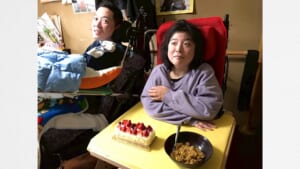
Now the disease has progressed. Both of them can only smile a little.
They may get pressure sores. At night, I need to suction their airway.
I cannot sleep well anymore.
I wake up every two hours, because they have seizures even at night.
Even small sounds wake me.
Because of epilepsy, no short-stay facilities will accept them.
Helpers come in the morning and evening.
They say, “If you collapse, it will be a big problem. Please take it easy.” But in reality, it is difficult.
Before, it was very hard to understand public support systems. Even when I asked, nobody could explain well. So I searched and used every system I could find.
***
This year, Hikaru turned 40. The city told me, “Now you must use long-term care insurance.”
But if we use long-term care insurance, all the services we used under disability support will now cost money.
They said, “With long-term care insurance, you can rent welfare equipment. You can get what you need depending on symptoms.” But now we don’t need rental.
We already bought everything with disability support money.
When we needed it, we could not rent. And now, when we don’t need it, they say, “You can rent.” That makes no sense.
Also, I cannot work full time because I never know when a seizure will happen. And still, they want me to pay for services? That is wrong.
I argued with the city. Finally, they agreed: “Until your child enters a facility, you can continue using disability services.”
But many people do not know this. They just move to long-term care insurance at 40 and start paying.
I want to tell everyone about this problem loudly.
***
It is useless to regret the disease now.
But I am so glad I met other DRPLA families. I feel, “I am not alone. Everyone has been fighting this path.” It gives me so much strength.
The DRPLA family group listens to my worries, gives advice, and gives me courage.
The DRPLA family group listens to my worries, gives advice, and gives me courage. We can talk about anything freely.
Also, my experience can help someone else.
Even people far away, I can talk with them face to face. We can share information. I am so thankful.
I truly hope medicine will come soon. I hope it can keep their condition as it is, or even better, help them speak a little, or show their feelings again.
That is my wish from my heart.