Our family consists of four members: my husband, myself, eldest son and second son.
Our youngest son, who is now 15 years old, has DRPLA. Our youngest son, who is now 15 years old, has DRPLA.
Since he was a baby, we felt that his development was delayed. I consulted doctors, but they told me it was within the range of normal individuality.
However, by the time he was 18 months old, he still couldn’t sit, stand, or walk on his own. That’s when we started early intervention therapy.
Despite undergoing many tests, no abnormalities were found, and we hoped he would eventually catch up.
He was a cheerful child who loved to eat and would roll over to chase after his older brother.
Before starting school, we attended an early intervention center together, traveling 1.5 hours each way by train. While other children gradually made progress, our son started showing signs of regression.
At age 5, an MRI revealed cerebellar atrophy. At age 7, he began experiencing seizures.
After entering a special needs school, eating by mouth became difficult.
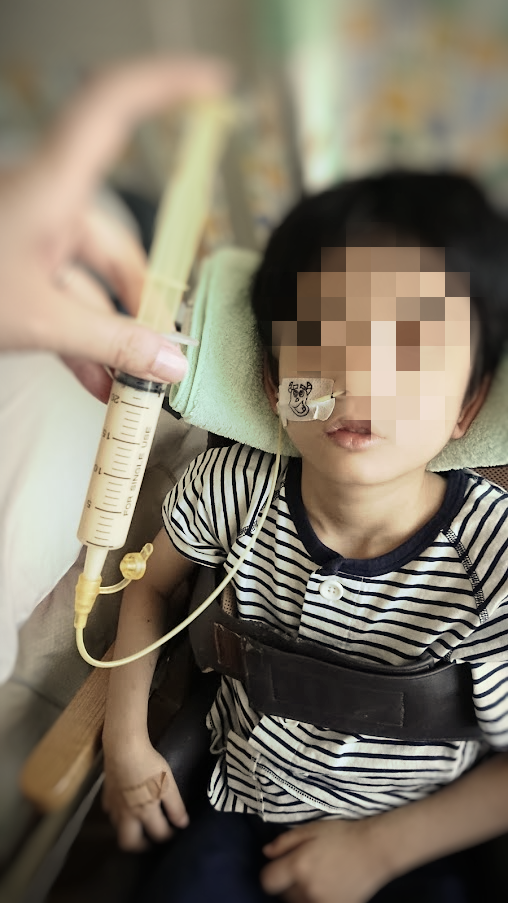
At age 9, he started receiving nutrition through a nasal tube, and at age 10, he underwent gastrostomy surgery.
Just before he turned 11, we received the confirmed diagnosis of DRPLA.
Now, at 15, he requires full assistance for daily life and is unable to communicate.
Without medication, he experiences severe muscle tightness, involuntary movements, and dystonia.
He takes around ten different medications through his feeding tube daily, which leaves him drowsy most of the time.
I often wonder how he feels about losing the abilities he once had—eating, smiling, sitting.
Now, even basic life-sustaining actions, such as breathing comfortably, swallowing saliva, and blinking, are becoming difficult.
I can’t help but wonder: is he happy?
Our family loves him deeply and will continue to protect him.
But the cruel reality of this disease is that my husband and eldest son might also develop it in the future.
When DRPLA appears in adulthood, it doesn’t just lead to the need for care—it also causes changes in personality.
This makes it difficult to discuss our situation openly, even with close relatives, as it may affect their future as well.
While support systems for children with severe disabilities are gradually improving, and we are grateful for the many people who support us, as a mother, I constantly feel deep anxiety, despair, and loneliness.
I want to work to support my family’s future, but caring for my son leaves me with little time.
A few years from now, I may find myself without a job, providing care for three beloved family members.
It feels as though I am walking through a dark tunnel with no exit.
My son has a repeat length of 81 (over 53 is considered abnormal, with higher numbers indicating more severe symptoms).
Five years ago, doctors told us that given the speed of his regression, even with all available medical treatments, he is unlikely to reach adulthood.
Still, meeting other families and dedicated professionals fighting this disease has given us strength.
We hold on to hope that advancements in medicine will bring change.
I hope that more people will learn about DRPLA and the families struggling with it. And one day, I pray that DRPLA will no longer be an untreatable, progressive, hereditary disease.
Thank you for listening.